Key points
- Instagram and Facebook serve different roles in a charity’s social media strategy. Instagram excels at awareness and discovery, like reaching new audiences through Reels, visual content, and shareability.
- Facebook drives deeper engagement and action through Groups, fundraising tools, and long-form storytelling.
- Rather than posting the same content to both, charities should treat each platform as a distinct stage in the supporter journey: Instagram at the top of the funnel, Facebook at the bottom. Use both together to move people from first impression to donation.
Many charities treat Instagram and Facebook as if they were the same platform. Some would even post the same content to both platforms and assume that they are reaching the same audience. However, this approach often leads to disappointing results because each platform rewards different types of content.
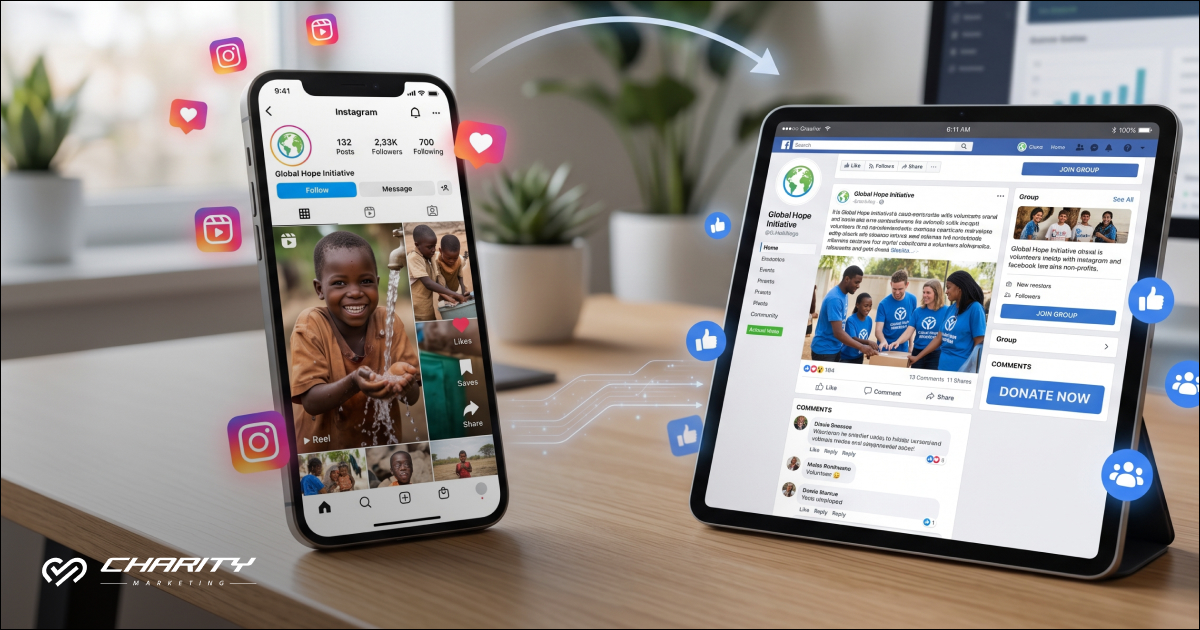
These platforms work very differently and that difference matters. Facebook and Instagram attract different audiences, encourage different behaviours, and support different stages of the donor journey.
Instagram is where people discover your cause. Facebook is where they decide to act. And for supporters somewhere in between, aware but not yet committed, each platform plays a specific role in moving them forward. Understanding which platform to use, and when, is what turns a scattered social media presence into a strategy that actually drives results.
Table of Contents
- Why Treating Instagram and Facebook the Same Hurts Your Results
- How Instagram Builds Awareness and Engagement
- How Facebook Moves Supporters From Awareness to Action
- How to Build a Stronger Strategy Across Both Platforms
- How This Looks in Practice
- How Leading Charities Use This Approach
- Reach More People and Drive Greater Impact
Why Treating Instagram and Facebook the Same Hurts Your Results
Posting the same content across Instagram and Facebook might feel like an efficient way to manage social media. For many charities with small teams, it seems like the simplest option.
However, this approach often leads to inconsistent results because each platform rewards different types of engagement. The same piece of content can perform very differently depending on where it’s published.
For example, average engagement rates are roughly 0.36% on Instagram compared to just 0.046% on Facebook—meaning Instagram can drive several times more interaction from the same audience. This gap highlights a critical point: what works on one platform will not automatically work on the other.1
For Instagram try:
- Reels
- Stories
- High-Res Images
For Facebook choose:
- Short & Long-Form Video
- Link Posts & Blogs
- Photo Albums & Text
- Facebook Groups & Lives
To understand why results vary so dramatically, you need to look at three core factors that define how each platform operates and what it rewards.
1. User Behaviour
The way people interact with content on Facebook and Instagram is fundamentally different. Facebook users tend to take their time. They are more likely to read through longer updates, react thoughtfully, and join discussions in the comments. This makes it easier for charities to share deeper stories and provide context around their work.
Instagram, on the other hand, is built around speed and visual impact. Users often scroll quickly, making split-second decisions about what to engage with. Content that is clear, visual, and emotionally compelling performs best because it captures attention immediately.
Because of this, a post that works well on Facebook may struggle on Instagram if it relies too heavily on text or explanation.
2. Audience Demographics
Facebook tends to attract an older and more established audience, many of whom are already in the habit of supporting causes financially. In fact, over half of users aged 30 to 64 report using Facebook daily, making it a strong platform for reaching people who are more likely to donate.2
Instagram leans much younger. Around 78% of people aged 18 to 29 use it, compared to only 35% of those in older age groups.3 These users are more likely to engage, share, and help spread your message, making Instagram a powerful tool for building awareness. This makes Instagram the perfect platform to launch a new initiative, a new campaign or fundraiser.
3. Algorithm Priorities
Each platform also prioritizes different types of engagement, which directly affects how far your content reaches. On Facebook, posts that generate conversation tend to perform better. Comments, shares, and meaningful interactions signal that a post is valuable, which increases its visibility in users’ feeds.4
Instagram places more weight on immediate engagement signals such as likes, saves, and video views.5
Because of this, Facebook tends to reward content that encourages back-and-forth interaction, while Instagram favours content that captures attention quickly and is easy to engage with.
How Instagram Builds Awareness And Engagement
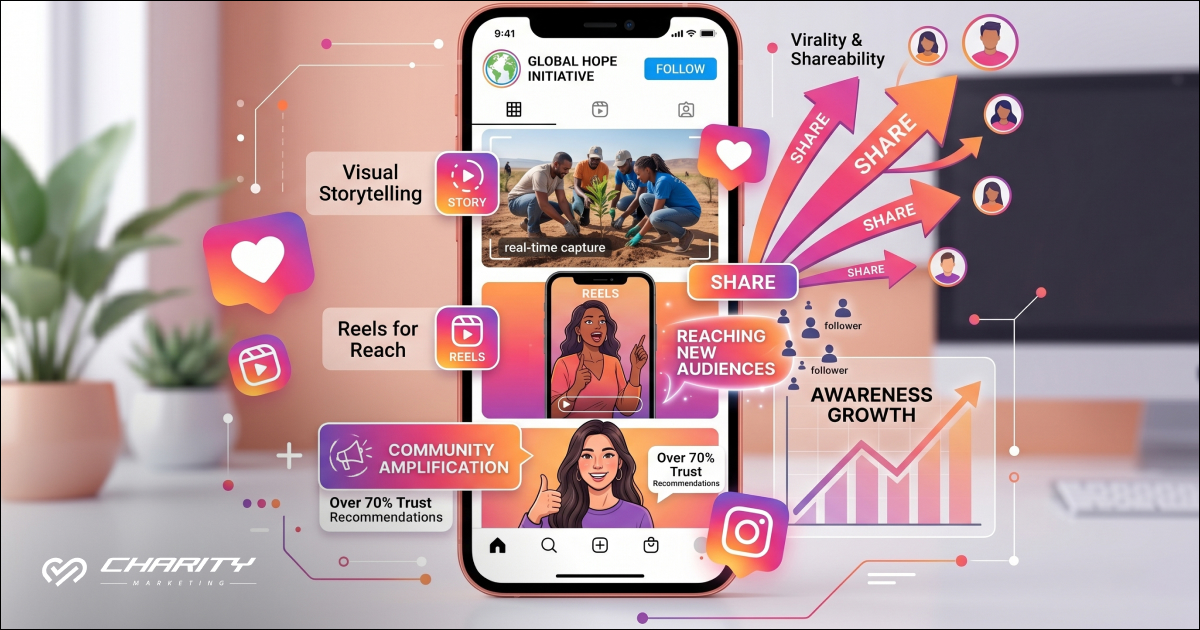
Instagram has become one of the most effective platforms for building awareness, especially for charities looking to reach new audiences. Here’s how organizations are leveraging the platform.
Reels for Reach & Discovery
One of the biggest advantages of Reels is their ability to reach beyond your existing audience. Instagram actively surfaces this type of content to users who have never interacted with your organization before.6 This makes Reels a key tool for discovery and growth, especially for charities trying to build awareness from the ground up.
Shareability
Sharing plays a big role in how content spreads on Instagram. When users connect with a post, they often pass it along to their own networks. This kind of interaction introduces your message to new audiences in a more personal way, since it comes from someone they already trust. Over time, this can significantly expand your reach and strengthen awareness.
Influencers / Community Amplification
Working with influencers or community partners allows charities to expand beyond their immediate reach. These collaborations introduce your cause to new audiences through voices people already follow and trust.
Recent data shows that trust in influencer recommendations is consistently high across multiple countries. More than 70% in countries like the US and UK, say they trust influencer recommendations.7
When your message is shared through a trusted voice, it is more likely to be taken seriously and passed along to others, helping your cause reach further.
How Facebook Moves Supporters From Awareness to Action
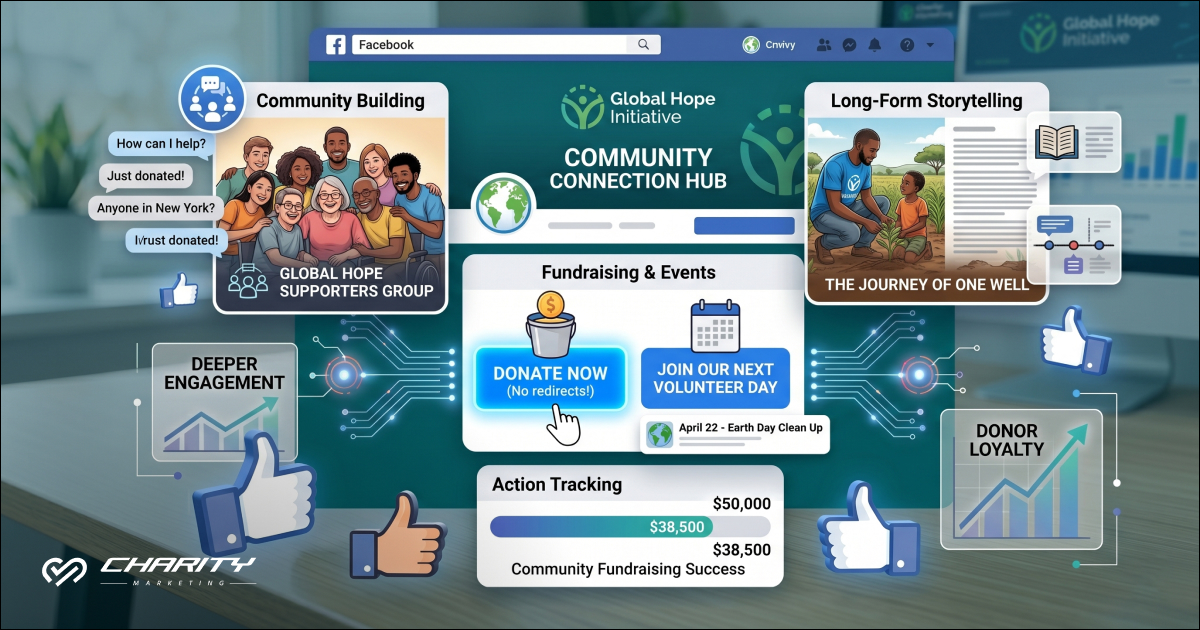
Facebook provides charities with a space to build stronger, more lasting connections with their audience. While platforms like Instagram are often used to capture attention, Facebook supports ongoing communication, deeper storytelling, and regular engagement. Here’s how charities are using Facebook to maintain those connections.
Community Building (Groups)
Facebook Groups allow charities to create a space where supporters can feel more involved. It’s not just about sharing updates. It’s about having a place where people can interact, ask questions, and connect with others who care about the same cause. Here are conversation-starter questions charities can post in their Facebook Group:
About impact
- What first made you care about [cause]?
- If you could see one change in [issue area] by the end of this year, what would it be?
About the community
- How did you first hear about us?
- What’s one thing you wish more people understood about [cause]?
Light and easy
- Share one word that describes why you support [cause]
- What song would be the soundtrack to our mission?
Prompting stories
- Has our work ever affected someone you know personally? We’d love to hear it.
- What made you decide to get involved rather than just scroll past?
Inviting opinions
- Which of our recent projects resonated most with you, and why?
- What would make you feel more connected to the work we do day to day?
When people feel like they are part of a community, they are more likely to stay engaged. They are not just following an organization. They are participating in something they believe in. That ongoing connection makes a big difference over time.
Fundraising Tools
One of Facebook’s biggest advantages for charities is its built-in fundraising features. Tools like Facebook Fundraisers and the Donate button make it easy for people to support a cause with just a few clicks. There is no need to redirect users to another site, which helps remove barriers to giving.
Facebook Fundraisers let supporters create their own fundraising pages directly on Facebook, either for a charity’s birthday, an event, or just because they want to. Donors can give without ever leaving the platform, and the charity receives the funds directly.
The Donate button appears on a charity’s Facebook Page or in posts and ads. It takes someone from “I want to help” to a completed donation in two or three taps, no redirects, no external checkout, no friction.
The reason both matter is that every extra step between intention and action costs you donors. Research consistently shows that conversion drops sharply when users are sent to another website. Keeping the entire transaction inside Facebook removes that drop-off entirely.
Events
Facebook Events help charities move beyond awareness and into participation. They provide a central place where supporters can learn about upcoming volunteer drives, fundraising events, and community activities.
By making it easy to show interest or commit to attending, events lower the barrier to getting involved. This creates more opportunities for people to take action and engage with the organization in a meaningful way.
How to Build a Stronger Strategy Across Both Platforms
Instead of choosing one platform over the other, the goal is to use both in a way that makes sense. Facebook and Instagram have helped raise over $5 billion in donations from millions of users worldwide, showing how common it has become to give directly through social platforms.8
To make this approach work, it helps to think in terms of a simple funnel. Each platform plays a role at a different stage of the supporter journey.
Top of Funnel (Awareness)
- Instagram Reels
- Visual content
This is where people first come across your cause. Instagram makes it easier to reach audiences who are not actively searching but are open to discovering new content as they scroll. Short videos and visual posts introduce your mission quickly, often in just a few seconds, which is critical when attention is limited.
At this stage, the goal is not to explain everything. It is to create interest and make your message memorable enough for someone to want to learn more.
Middle of Funnel (Engagement)
- Instagram Stories
- Facebook Groups
Once someone is aware of your cause, the next step is to keep them engaged. Instagram Stories play a key role here by providing consistent, low-effort touchpoints that keep your audience informed and interested over time.
Facebook Groups take this a step further by allowing for deeper interaction. They give supporters a place to engage directly with the organization and with each other, turning passive followers into active participants. This helps build stronger relationships and increases the likelihood of continued involvement.
Bottom of Funnel (Conversion)
- Facebook posts
- Fundraisers
- Events
This is where interest turns into action. By this stage, people are already familiar with your cause and have seen enough to understand its impact. Facebook provides clear opportunities to take the next step, whether that means donating, signing up, or getting involved.
Posts, fundraisers, and events make that decision easier by presenting a direct and immediate way to act. Because supporters have already engaged with your content earlier in the journey, they are more likely to follow through when the opportunity is presented.
How This Looks in Practice
A campaign might start with a Reel that highlights a real story and introduces the cause. People who engage with that content continue to see updates through Stories, which helps maintain interest. From there, they interact with Facebook content or join a group, where they gain a deeper understanding of the organization. When a fundraiser or event is shared, they are more likely to take action because they already feel connected to the cause.
How Leading Charities Use This Approach
Many of the most successful charity campaigns follow a similar pattern. They use different platforms to guide people from awareness to action, rather than relying on a single channel.
The ALS Ice Bucket Challenge is one of the clearest examples. It started with simple, engaging content that encouraged people to participate and share. As more people joined in, the campaign quickly spread across platforms. What made it effective was not just the visibility, but the way participation led directly to donations. Within a short period of time, it raised over $115 million, showing how awareness, engagement, and action can work together.9
Charity: Water takes a more long-term approach. It uses Instagram to introduce its mission through strong visual storytelling, helping people understand the impact of its work. Once that initial connection is made, Facebook and other channels are used to keep supporters informed and involved. Regular updates, project tracking, and transparent communication help build trust, making people more likely to support the organization over time.
UNICEF focuses on expanding reach through partnerships. By working with influencers and digital platforms, it is able to connect with audiences that might not otherwise engage with its campaigns. These collaborations help increase visibility while encouraging people to participate and share content, creating a wider impact.
Reach More People and Drive Greater Impact
The charities building audiences on both Instagram and Facebook right now are not just reaching more people. They are building resilience into their entire fundraising strategy.
Using both platforms allows charities to reach a wider range of supporters and avoid relying on a single channel for engagement.
Your mission deserves to be seen. Your stories deserve to be shared. Your supporters are waiting on both platforms—you just need to show up strategically.
Ready to build a social media strategy that actually works? The team at CharityMarketing specializes in helping nonprofits amplify their impact across every platform. Let’s talk.
References:
- Rival IQ. Social Media Industry Benchmark Report. Rival IQ, https://www.rivaliq.com/blog/social-media-industry-benchmark-report/.
- Pew Research Center. Americans’ Social Media Use 2025. 20 Nov. 2025, https://www.pewresearch.org/internet/2025/11/20/americans-social-media-use-2025/.
- JCK Online. Pew Research: Social Media Use. https://www.jckonline.com/editorial-article/pew-research-social-media-use/.
- Meta. News Feed FYI: Bringing People Closer Together. 11 Jan. 2018, https://about.fb.com/news/2018/01/news-feed-fyi-bringing-people-closer-together/.
- Instagram. Shedding More Light on How Instagram Works. https://about.instagram.com/blog/announcements/shedding-more-light-on-how-instagram-works.
- Instagram. Introducing Instagram Reels. https://about.instagram.com/blog/announcements/introducing-instagram-reels.
- Statista. Perceived Trustworthiness of Influencer Recommendations Worldwide 2024, by Country. https://www.statista.com/statistics/1550452/trust-in-recommendations-by-influencers-by-country/.
- Fox Business. Facebook, Instagram Generate $5B in Charitable Donations. https://www.foxbusiness.com/lifestyle/facebook-5b-in-charitable-donations.
ALS Association. ALS Ice Bucket Challenge. https://www.als.org/ibc.
You May Also Like