Key Points
- Small charities don’t need big budgets to succeed on social media — authenticity and storytelling outperform polished, high-budget content.
- Social media removes the barriers that once kept small charities invisible, giving them the ability to reach global audiences, build trust, and show real-time impact for free.
- The charities growing fastest post smarter, not more — leading with stories over statistics, showing up consistently, and always including a clear call to action.
- Engaging with your audience (replying to comments, asking questions, celebrating supporters) turns casual followers into committed advocates and fundraisers.
- Different platforms serve different purposes — Instagram for visual storytelling, Facebook for older donors and fundraisers, TikTok for explosive organic reach, and LinkedIn for corporate partnerships and funding.
Over a decade ago, videos of people dumping buckets of ice water over their heads took the internet by storm.
What looked like random teens and young adults pouring buckets of ice water for fun was actually a global fundraising movement.

The ALS Ice Bucket Challenge was one of the most successful charity campaigns in social media history. In the summer of 2014, it raised over $115 million for the ALS Association in the United States alone, dramatically increasing public awareness of amyotrophic lateral sclerosis (ALS) and accelerating funding for research and patient support.
And this was before TikTok, Instagram Reels, and the short-form video boom that now dominates our feeds.
The next campaign that captures the world’s attention does not have to come from a global organization. It could start with your team, your mission, and a story worth sharing.
Table of Contents
- The Myth That’s Holding Your Charity Back
- Why Social Media is the Great Equalizer for Charities
- What the Charities That Win on Social Media Do Differently
- The Platforms That Are Moving the Needle for Charities Right Now
The Myth That’s Holding Your Charity Back
It’s easy for small charities to look at large organizations online and think, “We can’t compete with that.” The big budgets, professional videos, and massive followings make it seem like social media success is out of reach.
That assumption does more harm than most charities realize — it is costing your cause dearly.
The rules aren’t what they used to be. High-budget content doesn’t automatically win attention anymore. People connect with what feels real.
Younger donors and volunteers in particular aren’t looking for perfect branding. They want to understand why something matters. They want to see the people behind the work and the lives being changed. That’s something small charities already have.
Why Social Media is the Great Equalizer for Charities
Just 1-2 decades ago, reaching 100,000 people meant paying for television airtime, print spreads, or a large-scale direct mail campaign. Today, one compelling post can do it for free — before breakfast.

Social media has dismantled the barriers that once kept small charities invisible. Here is what it gives you that nothing else can:
Reach without borders
You’re not restricted to your local community anymore. A small literacy charity in Glasgow can connect with supporters in Singapore. A rural food bank in Canada can capture attention across the United States. The world is now your donor base.
Trust at scale
When a supporter shares your post, they are personally vouching for your cause to everyone in their network. Word-of-mouth has always been the most powerful marketing tool — social media simply supercharges it.
Real-time impact storytelling
Supporters no longer have to wonder where their money went. You can show them. A £20 donation in the morning can become a photo, a short update, or a quick video by the afternoon. That immediacy creates a sense of involvement that an annual report simply can’t match.
A direct line to your community
Social media gives you a direct connection to the people who care about your work. It’s not just about posting updates. Every comment, every reply, every share is an opportunity to deepen your relationship with the people who care about your mission.
What the Charities That Win on Social Media Do Differently
The charities that are growing fastest on social media are not posting more — they are posting smarter. The difference comes down to a few non-negotiable principles.

They lead with story, not statistics
Numbers tell people what is happening. Stories make them feel why it matters. “We served 1,200 meals last month” is forgettable.
“Last Tuesday, Sarah came to us for the first time, shaking with cold. She hadn’t eaten in two days. Today she volunteers here every Thursday.”
That is the kind of content that stops people from scrolling.
They show up consistently
Virality is wonderful, but it is not a strategy. The charities building lasting audiences show up regularly, with content that is genuine, varied, and rooted in their mission. A good starting point is three to five posts per week. Enough to stay visible without sacrificing quality for volume.
Consistency builds visibility. It also builds recognition. When people see your charity regularly, they are more likely to pay attention when you ask them to take action.
They make it effortless to take action
Every high-performing charity post has a clear, single call to action. Confusion is the enemy of conversion, that’s why the charities winning on social media make the next step impossible to miss. Here’s what works best depending on what you’re trying to achieve:
To raise donations
- “Donate $[amount] today and [specific impact. E.g., feed a child for a week].”
- “Match our goal before midnight. Every pound counts.”
- “Give once. Change a life.”
To grow your volunteer base
- “We need [X] volunteers this [month/season]. Could you be one of them?”
- “Join us this [day]. No experience needed, just a willingness to help.”
- “See what volunteering with us looks like. [Link to a day-in-the-life post or video]”
To expand your reach
- “Tag someone who cares about [cause].”
- “Share this if you believe every child deserves [X].”
- “Know someone who’d want to help? Send them this.”
To build your email list or following
- “Follow us for weekly updates from the front lines of [cause].”
- “Sign up for our newsletter and see exactly where your support goes.”
To drive event attendance
- “Spots are filling up, reserve yours today.”
- “Bring a friend. The more the merrier, and the greater the impact.”
They engage, not just broadcast.
Responding to every comment. Asking questions. Celebrating your supporters publicly. This is the behaviour that transforms casual followers into committed advocates — and committed advocates into your most powerful fundraising asset.
The Platforms That Are Moving the Needle for Charities Right Now
Not all platforms are built equal, and your charity does not need to be everywhere. It starts with knowing where your potential donors are actually active and focusing your energy there instead of trying to be everywhere at once.

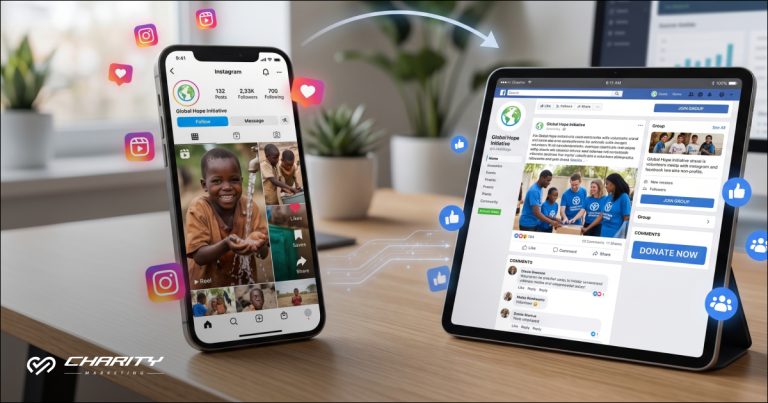
Instagram remains the dominant platform for visual storytelling. If your cause has a visible, emotional impact — and most do — Instagram Reels and Stories give you one of the most powerful free tools in digital marketing. Before-and-after content, behind-the-scenes moments, and beneficiary stories perform extraordinarily well here.
Facebook still reaches a large share of active donors, especially those over 35. For many charities, it remains a reliable place to run fundraisers, host community groups, and stream live events that bring in meaningful support.
TikTok is no longer a platform charities can afford to dismiss. Its algorithm is uniquely democratic — a new account with zero followers can reach millions overnight with the right content. Charities working with young people, animals, or urgent humanitarian causes are seeing explosive growth here.
LinkedIn is the underutilized powerhouse for charities seeking corporate partnerships, grant funding, and professional volunteers. A well-crafted LinkedIn presence can open doors that no cold email ever could.
Your Charity’s Moment Is Now
Here is something we believe without reservation: every cause that is changing lives deserves to be known. The work your charity does matters profoundly — and the world should know about it.

Social media is no longer optional for charities. It has become one of the most effective and affordable ways to reach the people who may choose to donate, volunteer, or advocate for your cause. What makes the difference is not just being present, but being intentional about how you use it.
The charities that will define the next decade are not necessarily the ones with the biggest legacy or the deepest pockets. They are the ones who master the art of digital storytelling — who learn to move hearts, inspire action, and build communities online.
That could be your charity. It should be your charity.
Ready to Transform What Social Media Can Do for Your Cause?
At CharityMarketing, we exist for one reason: to help charities like yours get seen, heard, and funded through the power of digital marketing. We know your world — the budget pressures, the small teams, the enormous hearts, and the causes that deserve every bit of support they can get.

We build social media strategies that don’t just grow your following — they grow your impact. Let’s start the conversation.
You May Also Like